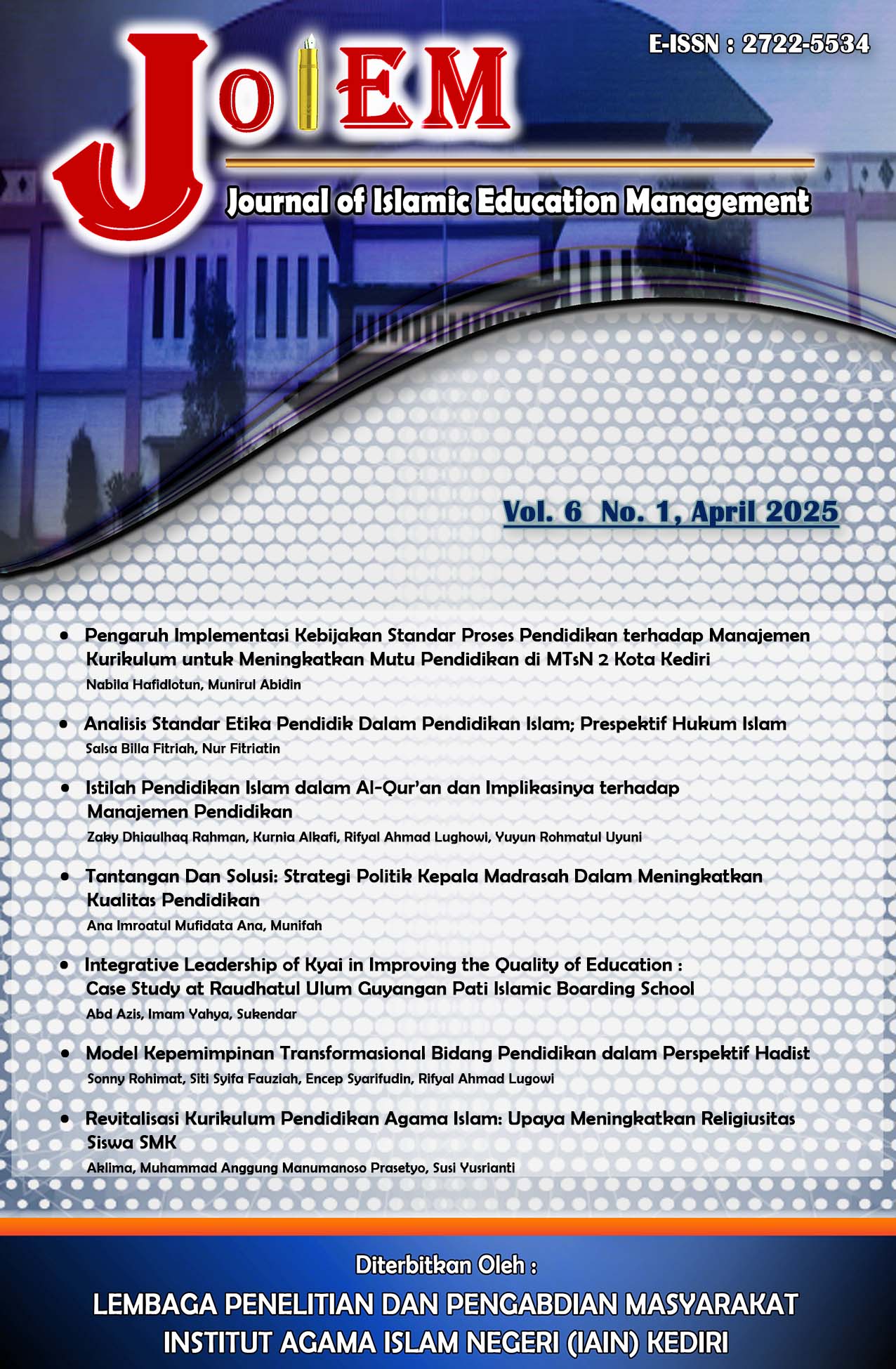
Pengaruh Implementasi Kebijakan Standar Proses Pendidikan terhadap Manajemen Kurikulum untuk Meningkatkan Mutu Pendidikan di MTsN 2 Kota Kediri
DOI:
https://doi.org/10.30762/joiem.v6i1.4203Keywords:
kebijakan standar proses pendidikan, Manajemen Kurikulum, mutu pendidikan, Leadership Effectiveness, School Principal, School QualityAbstract
The purpose of this study was to determine: The effectiveness of the principal's leadership in improving school quality at SMA Muhammadiyah 1 Medan. This research uses a mixed method approach, with the research design being the exploratory sequential. The data collection techniques used are observation, interviews, documentation, and questionnaires. Qualitative data analysis techniques in this case use data reduction, data presentation, conclusion drawing. As for quantitative data analysis techniques in this study, namely using simple linear regression tests. The results of this study indicate that the leadership of the principal of SMA Muhammadiyah 1 Medan is effective in improving school quality with a leadership style that is lived, namely participatory-transformational. Principals improve the quality of schools can be influenced and there is a relationship with indicators of teacher performance whose influence is 15.5%, the school organizational climate is 27.5%, students enter college 26%, student achievements are 31%, and the graduation of students in taking the National Exam 100% pass.
Downloads
References
Ahmad, A. (2024). Model Perencanaan Pendidikan Berkelanjutan untuk Meningkatkan Mutu Pembelajaran di Sekolah Dasar. MODELING: Jurnal Program Studi PGMI, 11(1), Article 1. https://doi.org/10.69896/modeling.v11i1.2536
Akbar, M., Putri, N. K., Febriani, S., Abunoya, J. I., & Sukemi, S. (2023). Literature Review: Analysis Of Weakness and Inhibiting Factors In The Implementation Of The Merdeka Curriculum. PROSIDING SEMINAR NASIONAL KIMIA, 2(1), 106–111.
Alfatih, A. (2021). Cara Mudah Kerjakan Penelitian Metode Kuantitatif Eksplanatif (Confirmatory) 2 Variable: X dan Y. Palembang: Universitas Sriwijiaya.
Allejar, M. (2017). Pengaruh Implementasi Kebijakan Standar Proses Pendidikan terhadap Manajemen Kurikulum untuk Mewujudkan Efektivitas Pembelajaran. Khazanah Akademia, 1(01), Article 01.
Changiz, T., Yamani, N., Tofighi, S., Zoubin, F., & Eghbali, B. (2019). Curriculum management/monitoring in undergraduate medical education: A systematized review. BMC Medical Education, 19(1), 60. https://doi.org/10.1186/s12909-019-1495-0
Fahma, H., Khomairoh, S. M. H., Afriza, & Amin, M. (2024). KONSEPTUALISASI KEBIJAKAN PENDIDIKAN TINGKAT MIKRO. Jurnal Ilmiah Multidisiplin Terpadu, 8(6), Article 6. https://oaj.jurnalhst.com/index.php/jimt/article/view/2136
Gursoy, D., & Umbreit, W. T. (2005). Exploring Students’ Evaluations of Teaching Effectiveness: What Factors are Important? Journal of Hospitality & Tourism Research, 29(1), 91–109. https://doi.org/10.1177/1096348004268197
Haddade, H., Nur, A., Achruh, A., Rasyid, M. N. A., & Ibrahim, A. (2024). Madrasah management strategies through Madrasah Reform program: An evidence from Indonesia. International Journal of Educational Management, 38(5), 1289–1304. https://doi.org/10.1108/IJEM-05-2023-0236
Huda, N. (2017). MANAJEMEN PENGEMBANGAN KURIKULUM. AL-TANZIM : JURNAL MANAJEMEN PENDIDIKAN ISLAM, 1(2), 52–75. https://doi.org/10.33650/al-tanzim.v1i2.113
Karmiyati, K. (2023). STRATEGI PENGEMBANGAN MANAJEMEN KURIKULUM DI MADRASAH (STUDI VISIONER DALAM MENDIDIK SISWA PADA JENJANG PENDIDIKAN DASAR). Khidmat, 1(1), Article 1.
Kuleto, V., Ilić, M. P., Šević, N. P., Ranković, M., Stojaković, D., & Dobrilović, M. (2021). Factors Affecting the Efficiency of Teaching Process in Higher Education in the Republic of Serbia during COVID-19. Sustainability, 13(23), 12935. https://doi.org/10.3390/su132312935
Lawrence, J. E., & Tar, U. A. (2018). Factors that influence teachers’ adoption and integration of ICT in teaching/learning process. Educational Media International, 55(1), 79–105. https://doi.org/10.1080/09523987.2018.1439712
Lazwardi, D. (2017). MANAJEMEN KURIKULUM SEBAGAI PENGEMBANGAN TUJUAN PENDIDIKAN. Al-Idarah : Jurnal Kependidikan Islam, 7(1), 119–125. https://doi.org/10.24042/alidarah.v7i1.1112
Mahrus, M. (2021). Manajemen Kurikulum dan Pembelajaran dalam Sistem Pendidikan Nasional. JIEMAN: Journal of Islamic Educational Management, 3(1), 41–80. https://doi.org/10.35719/jieman.v3i1.59
Masri, M., Rusdinal, R., & Gistituati, N. (2024). Implementasi kebijakan pendidikan kurikulum merdeka belajar. JRTI (Jurnal Riset Tindakan Indonesia), 8(4), Article 4. https://doi.org/10.29210/30032794000
Muschamp, Y., Pollard, A., & Sharpe, R. (1992). Curriculum management in primary schools. The Curriculum Journal, 3(1), 21–39. https://doi.org/10.1080/0958517920030104
Nukhbatillah, I. A., Dhiaulhaq, F., Hilma, D., & Hidayat, Y. (2023). Implementasi Standar Proses Pembelajaran di MI Condong Kota Tasikmalaya Perspektif Islam. Al-Fiqh, 1(2), 61–70. https://doi.org/10.59996/al-fiqh.v1i2.198
Pring, R. (1992). Standards and quality in education. British Journal of Educational Studies, 40(1), 4–22. https://doi.org/10.1080/00071005.1992.9973907
Rahayu, M. S., Hasan, I., Asmendri, A., & Sari, M. (2023). RELAVANSI KURIKULUM DAN PEMBELAJARAN DALAM PENDIDIKAN. Dharmas Education Journal (DE_Journal), 4(1), 108–118. https://doi.org/10.56667/dejournal.v4i1.925
Resnick, L. B. (1994). Introduction: Standards, Assessment, and Educational Quality. Journal for the Education of the Gifted, 17(4), 407–420. https://doi.org/10.1177/016235329401700406
Ridwanulloh, M. U. (2024). Inovasi Pendidikan: Meningkatkan Kualitas Pendidikan, Menjawab Tantangan Zaman—Penelusuran Google. Intrans Publishing. https://www.google.com/search?q=Inovasi+Pendidikan%3A+Meningkatkan+Kualitas+Pendidikan%2C+Menjawab+Tantangan+Zaman&rlz=1C1YTUH_idID1001ID1001&oq=Inovasi+Pendidikan%3A+Meningkatkan+Kualitas+Pendidikan%2C+Menjawab+Tantangan+Zaman&gs_lcrp=EgZjaHJvbWUyBggAEEUYOTIGCAEQRRg80gEHMzE5ajBqN6gCALACAA&sourceid=chrome&ie=UTF-8
Rizqiyah, A., Fayaz Mahassin Syifa’i Adienk, & Eko Arif Ilhami A’abadia. (2023). KOMPARASI KEBIJAKAN TUGAS AKHIR DALAM PERMENDIKBUD NO. 3 TAHUN 2020 DENGAN PERMENDIKBUDRISTEK NO. 53 TAHUN 2023. Istifkar, 3(2), 106–121. https://doi.org/10.62509/ji.v3i2.90
Setyawan, B. W. (2022). Model Pengelolaan Fullday School untuk Menumbuhkan Karakter Islami pada Siswa SMA di Kota Surakarta. JoIEM (Journal of Islamic Education Management), 2(1), 1–17. https://doi.org/10.30762/joiem.v2i1.3128
Siroj, R. A., Afgani, W., Fatimah, F., Septaria, D., & Salsabila, G. Z. (2024). Metode penelitian kuantitatif pendekatan ilmiah untuk analisis data. Jurnal Review Pendidikan Dan Pengajaran (JRPP), 7(3), 11279–11289.
Sopwandin, I., Yusman, R., Hak, R. B., Putra, R., & Alim, U. (2023). Manajemen Kurikulum dalam Mengembangkan Mutu Pendidikan. J-MPI (Jurnal Manajemen Pendidikan Islam), 8(1), 94–106. https://doi.org/10.18860/jmpi.v8i1.19210
Soro, S. H., Suherman, M., Rachmawati, S., & Ardiansyah, Y. (2024). Manajemen Kurikulum dalam Meningkatkan Mutu Pendidikan (Studi Kasus di SD Negeri Puncak 2). EDUKASIA: Jurnal Pendidikan Dan Pembelajaran, 5(1), Article 1. https://doi.org/10.62775/edukasia.v5i1.1305
Sukatin, Danny, M. A. F., Huda, R. M., & Fajria, Z. I. (2023). MANAJEMEN KURIKULUM DAN EVALUASI. Educational Leadership: Jurnal Manajemen Pendidikan, 2(2), 247–262. https://doi.org/10.24252/edu.v2i2.35257
Syupriyanti, L., Marsidin, S., & Sabandi, A. (2020). Kebijakan Standar Proses di Sekolah dasar. EDUKATIF : JURNAL ILMU PENDIDIKAN, 2(2), 134–143. https://doi.org/10.31004/edukatif.v2i2.116
Triwiyanto, T., Suyanto, & Prasojo, L. D. (2020). Policies and Aspects of Educational Management of the Indonesian Government in Response to International Standardization: Proceedings of the 1 St International Conference on Information Technology and Education (ICITE 2020). 1st International Conference on Information Technology and Education (ICITE 2020), Malang, Indonesia. https://doi.org/10.2991/assehr.k.201214.220
Zaenul Ibad, A., & Nurazami, D. S. (2022). IMPLEMENTASI MANAJEMEN KURIKULUM DALAM MENINGKATKAN MUTU PENDIDIKAN (Studi Kasus Di SMP N 7 Pemalang). Jurnal Ilmiah Ibtida, 3(2), 156–167. https://doi.org/10.58410/ibtida.v3i2.578
Downloads
Published
How to Cite
Issue
Section
License
Copyright (c) 2025 Nabila Hafidlotun, Munirul Abidin

This work is licensed under a Creative Commons Attribution-ShareAlike 4.0 International License.