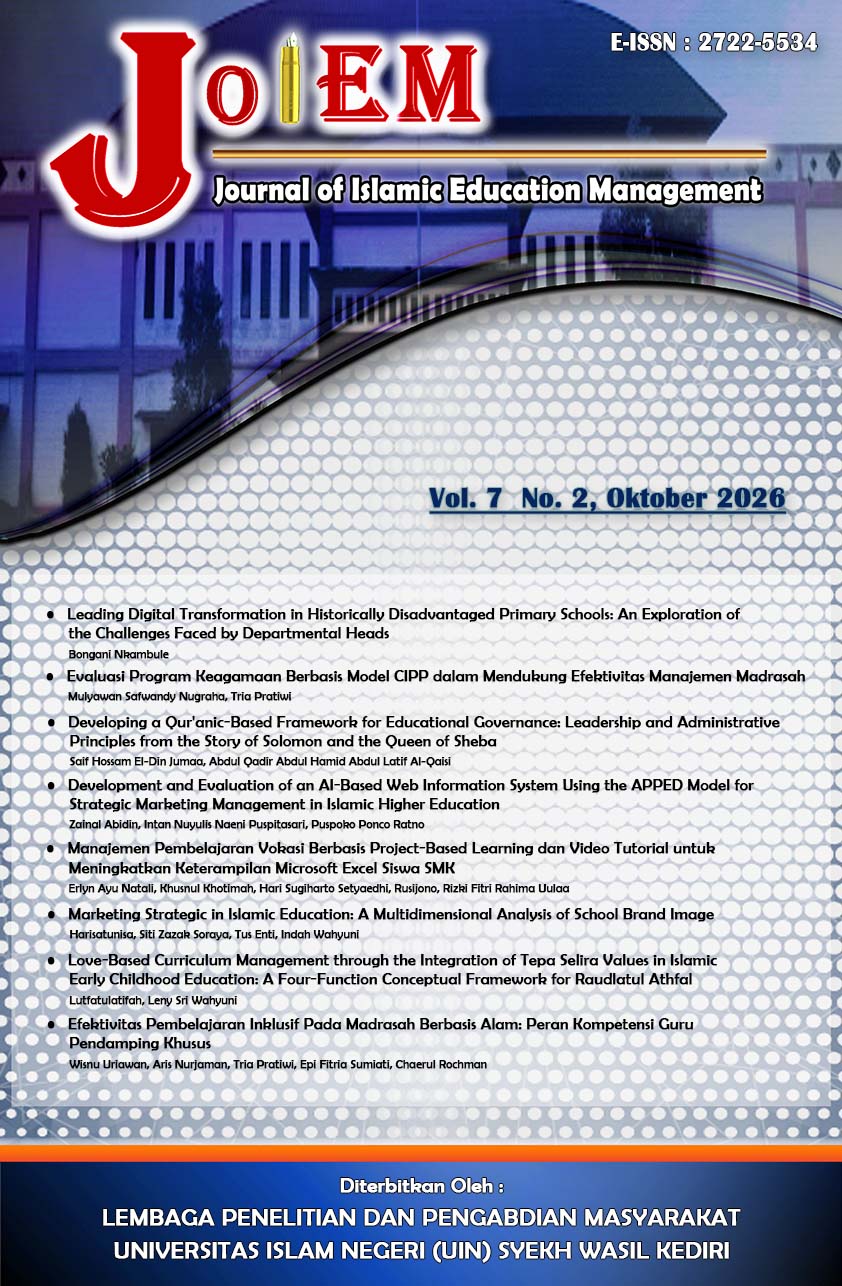
Efektivitas Pembelajaran Inklusif Pada Madrasah Berbasis Alam: Peran Kompetensi Guru Pendamping Khusus
DOI:
https://doi.org/10.30762/joiem.v7i2.9211Keywords:
special education teacher, learning effectiveness, inclusive education, competence, nature-based madrasahAbstract
Inclusive education in nature-based madrasahs requires Special Education Assistants (GPK) who can bridge the needs of students with special educational needs with Islamic curricula and nature-based learning. This study aims to analyze the relationships between GPK pedagogical, professional, and social-collaborative competencies and the effectiveness of inclusive learning at a nature-based Islamic elementary school (MI) in Bandung Regency. The study employed a quantitative approach with an explanatory research design. The sample consisted of 13 GPK selected through total sampling. Data were collected using a 4-point Likert-scale questionnaire and analyzed using Partial Least Squares-Structural Equation Modeling (PLS-SEM) with an exploratory and contextual interpretation. The results showed that pedagogical competence had the strongest positive relationship (β=0.916; f²=0.419), while professional competence showed a relatively small direct relationship with a negative direction (β=−0.279; f²=0.048), and social-collaborative competence showed a very small direct relationship (β=0.027; f²=0.001). The model explained 51.3% of the variance in inclusive learning effectiveness. Given the limited sample size, the findings are interpreted contextually and are not broadly generalizable.
Downloads
References
Achmad, S., & Samaeng, W. A. (2025). Inclusive Education Management for Children with Special Needs in Madrasah Ibtidaiyah. MUDARRISA: Jurnal Kajian Pendidikan Islam, 17(1), 29–55. https://doi.org/10.18326/mudarrisa.v17i1.3413
Ainscow, M. (2020). Promoting inclusion and equity in education: lessons from international experiences. Nordic Journal of Studies in Educational Policy, 6(1), 7–16. https://doi.org/10.1080/20020317.2020.1729587
Donath, J. L., Lüke, T., Graf, E., Tran, U. S., & Götz, T. (2023). Does professional development effectively support the implementation of inclusive education? A meta-analysis. Educational Psychology Review, 35, Article 30. https://doi.org/10.1007/s10648-023-09752-2
Florian, L., & Black-Hawkins, K. (2011). Exploring inclusive pedagogy. British Educational Research Journal, 37(5), 813–828. https://doi.org/10.1080/01411926.2010.501096 Global Education Monitoring Report Team. (2020). Global Education Monitoring Report 2020: Inclusion and education: All means all. Paris. UNESCO.
Graham, L. J., & Spandagou, I. (2011). From vision to reality: views of primary school principals on inclusive education in New South Wales, Australia. Disability & Society, 26(2), 223–237. https://doi.org/10.1080/09687599.2011.544062
Guo, L., & Keles, S. (2026). In-service general education teachers’ competence for inclusive education: A systematic scoping review and evidence-gap map. European Journal of Special Needs Education, 41(5), 1073–1090. https://doi.org/10.1080/08856257.2026.2614662
https://doi.org/10.54676/JJNK6989
Ilyas, E. L., Setyaningrum, N., & Sumarni, S. (2022). A model of inclusive education curriculum in Islamic education institutions: A case study in Banten Province, Indonesia. Jurnal Pendidikan Agama Islam, 19(2), 193–206. https://doi.org/10.14421/jpai.2022.192-02
Karomi, Murah, Syahidallah, & Junayanti, M. (2024). Analisis implementasi kurikulum Merdeka di sekolah inklusif di Kabupaten Lombok Timur. JoIEM (Jurnal Manajemen Pendidikan Islam), 5 (2), 88–98. https://doi.org/10.30762/joiem.v5i2.3626
Karya Bakti, I., Kurniawan, R., Mukhlishah, Mudlofir, A., Kusaeri, & Bahri, R. (2026). Integrating Islamic values in inclusive madrasa education: A unique approach for special needs students. International Journal of Inclusive Education, 30(8), 2079–2095. https://doi.org/10.1080/13603116.2025.2555397
Kazanopoulos, S., Mouchritsa, M., Tejada Garitano, E., & Basogain Olabe, X. (2021). Collaboration between in-service school teachers and families in the context of inclusive education: A review of the recent literature. Journal of Education and Practice, 12(6). https://doi.org/10.7176/JEP/12-6-05
Kusuma, D. F. (2025). Construct Validation Of Special Education Teacher Competencies For Inclusive Education: A Confirmatory Analysis Approach. Jurnal Didaktika Pendidikan Dasar, 9(3), 1185–1206. https://doi.org/10.26811/didaktika.v9i3.1994
Mann, J., Gray, T., Truong, S., Brymer, E., Passy, R., Ho, S., Sahlberg, P., Ward, K., Bentsen, P., Curry, C., & Cowper, R. (2022). Getting out of the classroom and into nature: A systematic review of nature-specific outdoor learning on school children's learning and development. Frontiers in Public Health, 10, Article 877058. https://doi.org/10.3389/fpubh.2022.877058
Mu’is, A., Baharun, H., & Suwandi, S. (2022). Humanistic based Inclusive Education Management in Madrasah: Policy Review. AL-TANZIM: Jurnal Manajemen Pendidikan Islam, 6(3), 894–906. https://doi.org/10.33650/al-tanzim.v6i3.3574
Muhyani, & Shidqy, M. (2026). Inclusive Islamic and nature-based primary school model. Attadib: Journal of Elementary Education, 9(3). https://doi.org/10.32832/at-tadib.v9i3.22228
Musyakkir, M., Raudhatunnur, R., Salsabilla, N., & Suprihatiningrum, J. (2025). Islamic educational values in inclusive learning practices: A case study at a primary school in Yogyakarta. Lentera Pendidikan: Jurnal Ilmu Tarbiyah dan Keguruan, 28(1), 259–272. https://doi.org/10.24252/lp.2025v28n1i15
Sari, L. P., & Sari, M. N. (2026). Principal leadership, organizational culture, and work motivation: Determinants of teachers’ pedagogic competency at inclusion schools in Sleman Regency. Journal of Educational Sciences, 10(8), 1–24. https://doi.org/10.31258/jes.10.8.p.1-24, link https://jes.ejournal.unri.ac.id/index.php/JES/article/view/1559
Schnepel, S., Luger, S., Wehren-Müller, M., & Moser Opitz, E. (2025). The role of teacher attitudes and collaboration for inclusive teaching practices. Teaching and Teacher Education, 168, Article 105240. https://doi.org/10.1016/j.tate.2025.105240
Sharma, U., Loreman, T., & Forlin, C. (2012). Measuring teacher efficacy to implement inclusive practices. Journal of Research in Special Educational Needs, 12(1), 12–21. https://doi.org/10.1111/j.1471-3802.2011.01200.x
UNESCO. (2015). Incheon Declaration Framework for Action for the implementation of Sustainable Development Goal 4 Ensure inclusive and equitable quality education and promote lifelong learning opportunities for all.
Valdés, R., Améstica, J. M., & Coronado, C. (2026). Educational leadership for inclusive education: A systematic literature review. Cogent Education, 13(1), Article 2666707. https://doi.org/10.1080/2331186X.2026.2666707
Wood, S., Stocker, K., Sharma, U., & Leif, E. (2026). A scoping review of the components of effective teacher in-service professional development in inclusive education. International Journal of Inclusive Education. https://doi.org/10.1080/13603116.2025.2554251
Woodcock, S., Sharma, U., Subban, P., & Hitches, E. (2022). Teacher self-efficacy and inclusive education practices: Rethinking teachers’ engagement with inclusive practices. Teaching and Teacher Education, 117, Article 103802. https://doi.org/10.1016/j.tate.2022.103802
Wray, E., Sharma, U., & Subban, P. (2022). Factors influencing teacher self-efficacy for inclusive education: A systematic literature review. Teaching and Teacher Education, 117, Article 103800. https://doi.org/10.1016/j.tate.2022.103800
Wulandari, R. S., & Hendriani, W. (2021). Kompetensi pedagogik guru sekolah inklusi di Indonesia (Suatu pendekatan systematic review). Jurnal Kependidikan: Jurnal Hasil Penelitian dan Kajian Kepustakaan di Bidang Pendidikan, Pengajaran dan Pembelajaran, 7(1). https://doi.org/10.33394/jk.v7i1.3152
Downloads
Published
How to Cite
Issue
Section
License
Copyright (c) 2026 Wisnu Uriawan, Aris Nurjaman, Tria Pratiwi, Epi Fitria Sumiati, Chaerul Rochman

This work is licensed under a Creative Commons Attribution-ShareAlike 4.0 International License.