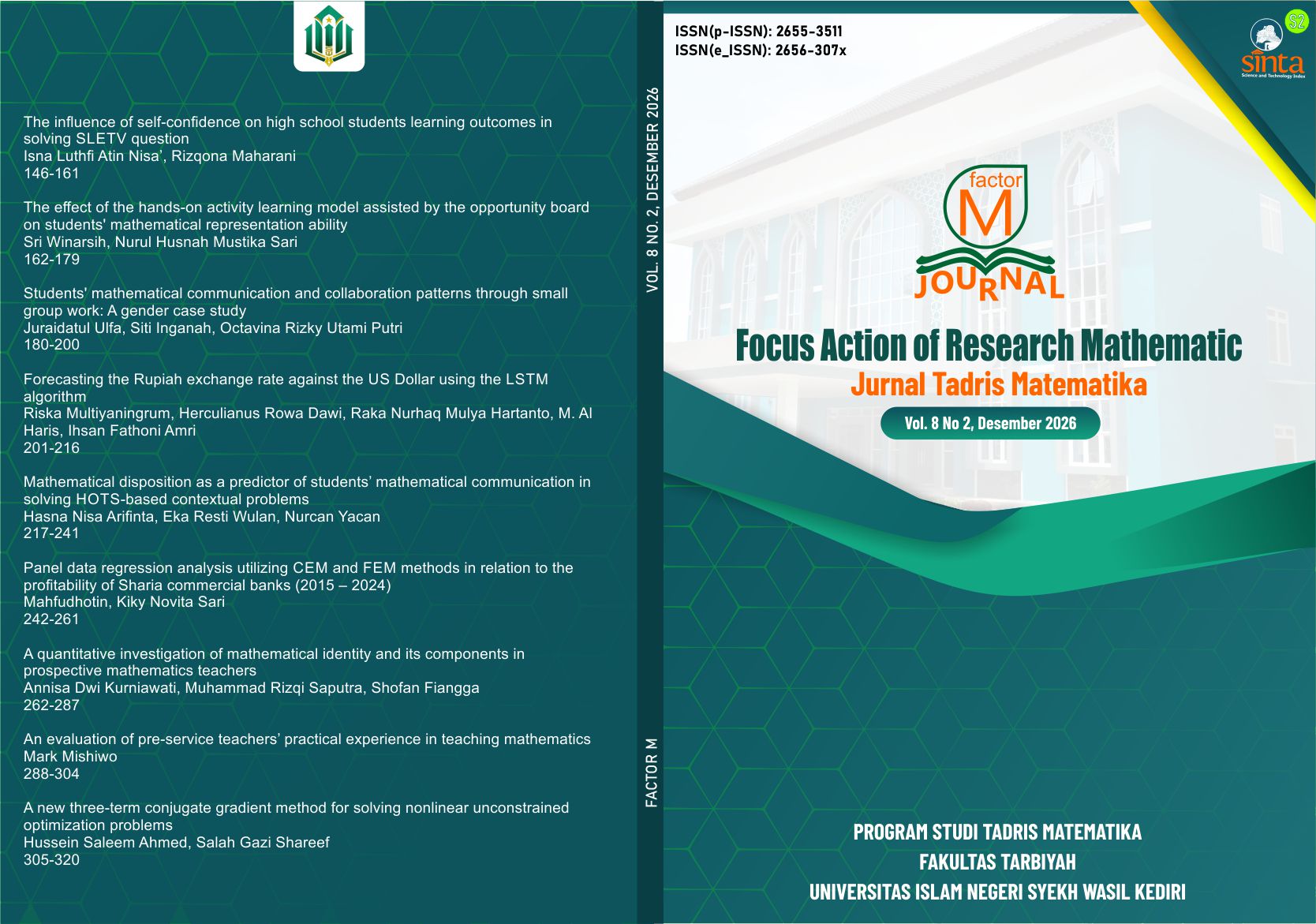
Forecasting the Rupiah exchange rate against the US Dollar using the LSTM algorithm
DOI:
https://doi.org/10.30762/f_m.v8i2.6530Keywords:
Exchange Rate, Forecasting, LSTMAbstract
Exchange rates are a vital indicator of an economy's balance. The fluctuations of Indonesia's currency, the rupiah, against the USD influenced trade patterns, investment, and both monetary and fiscal policy. Exchange rate fluctuations affect international trade, investment, inflation, and overall economic stability. The high volatility of the Rupiah against the USD, driven by macroeconomic and monetary factors, has a significant impact on national economic policy, necessitating research that utilizes the latest data and adaptive models. To capture the nonlinear and complicated behavior of exchange rates, an advanced methodology for forecasting is needed. This journal utilizes the Long Short-Term Memory (LSTM) neural network model to forecast the exchange rate of the rupiah towards the dollar from March 1, 2022, up to February 28, 2025, in daily data. The data used in this research are sourced from www.bi.go.id, which provides the official daily exchange rate of USD to IDR. The Long Short-Term Memory method was chosen for modeling long-term dependencies within time series. After normalization, an 80/20 split is performed for training and testing on the dataset. The network runs optimization using three hidden layers with 50 neurons each and a batch size of 32 for 200 epochs. The optimal configuration, achieved through experimental trials, consisted of two hidden layers with 50 neurons, a batch size of 32, and 200 epochs. This is manifest in the fact that LSTM effectively captures movements in exchange rates, with an RMSE of 0.6226 and a MAPE of 0.3031%. This degree of accuracy enables the model to inform economic policy decisions based on data.
Downloads
References
Ahmed, R. (2021). Monetary policy spillovers under intermediate exchange rate regimes. Journal of International Money and Finance, 112, 102342. https://doi.org/10.1016/j.jimonfin.2020.102342
Aksu, G., Güzeller, C. O., & Eser, M. T. (2019). The effect of the normalization method used in different sample sizes on the success of artificial neural network model. International Journal of Assessment Tools in Education, 6(2), 170–192. https://doi.org/10.21449/ijate.479404
Alfira, N., Fasa, M. I., & Suharto, S. (2021). Pengaruh covid-19 terhadap indeks harga saham gabungan (IHSG) dan nilai tukar rupiah. Al-Kharaj: Jurnal Ekonomi, Keuangan & Bisnis Syariah, 3(3), 313–323.
Ananda, W. C., & Santoso, A. B. (2022). Pengaruh inflasi, suku bunga, dan nilai tukar Rupiah terhadap return saham pada perusahaan perbankan yang terdaftar di Bursa Efek Indonesia (2018-2020). J-MAS (Jurnal Manajemen Dan Sains), 7(2), 726–733. http://dx.doi.org/10.33087/jmas.v7i2.559
Ardesfira, G., Zedha, H. F., Fazana, I., Rahmadhiyanti, J., Rahima, S., & Anwar, S. (2022). Peramalan nilai tukar rupiah terhadap dollar amerika dengan menggunakan metode autoregressive integrated moving average (ARIMA). Jambura Journal of Probability and Statistics, 3(2), 71–84. https://doi.org/10.34312/jjps.v3i2.15469
Ashari, M. L., & Sadikin, M. (2020). Prediksi data transaksi penjualan time series menggunakan regresi LSTM. Jurnal Nasional Pendidikan Teknik Informatika: JANAPATI, 9(1), 1–10. https://doi.org/10.23887/janapati.v9i1.19140
Cerchiello, P., Nicola, G., Rönnqvist, S., & Sarlin, P. (2022). Assessing banks’ distress using news and regular financial data. Frontiers in Artificial Intelligence, 5, 871863. https://doi.org/10.3389/frai.2022.871863
Choudhri, E. U., & Hakura, D. S. (2015). The exchange rate pass-through to import and export prices: The role of nominal rigidities and currency choice. Journal of International Money and Finance, 51, 1–25. https://doi.org/10.1016/j.jimonfin.2014.09.006
Çitçi, S. H., & Kaya, H. (2023). Exchange rate uncertainty and the connectedness of inflation. Borsa Istanbul Review, 23(3), 723–735. https://doi.org/10.1016/j.bir.2023.01.009
Corzo, T., Martin-Bujack, K., Portela, J., & Rodríguez-Gallego, A. (2025). Exchange rate regime changes and market efficiency: An event study. Journal of International Financial Markets, Institutions and Money, 100, 102132. https://doi.org/10.1016/j.intfin.2025.102132
Devi, A., & Hendikawati, P. (2024). Prediksi kurs rupiah terhadap dolar dengan menggunakan model long-short term memory. PRISMA, Prosiding Seminar Nasional Matematika, 7, 882–891.
Fang, Z., Ma, X., Pan, H., Yang, G., & Arce, G. R. (2023). Movement forecasting of financial time series based on adaptive LSTM-BN network. Expert Systems with Applications, 213, 119207. https://doi.org/10.1016/j.eswa.2022.119207
Fayyad, M. F., Kurniawan, V., Anugrah, M. R., Estanto, B. H., & Bilal, T. (2024). Application of Recurrent Neural Network Bi-Long Short-Term Memory, Gated Recurrent Unit and Bi-Gated Recurrent Unit for forecasting rupiah against dollar (USD) exchange rate. Public Research Journal of Engineering, Data Technology and Computer Science, 2(1), 1–10. https://doi.org/10.57152/predatecs.v2i1.1094
Golazad, S., Mohammadi, A., Rashidi, A., & Ilbeigi, M. (2024). From raw to refined: Data preprocessing for construction machine learning (ML), deep learning (DL), and reinforcement learning (RL) models. Automation in Construction, 168, 105844. https://doi.org/10.1016/j.autcon.2024.105844
Gori, T., Sunyoto, A., & Al Fatta, H. (2024). Preprocessing data dan klasifikasi untuk prediksi kinerja akademik siswa. Jurnal Teknologi Informasi Dan Ilmu Komputer, 11(1), 215–224. https://doi.org/10.25126/jtiik.20241118074
Hidayah, N., & Fernanda, J. (2021). Analisis penerimaan aplikasi pembelajaran online menggunakan technology acceptance model 3 dan partial least square structural equation model (PLS-SEM). Journal Focus Action of Research Mathematic (Factor M), 3(2), 161–172. https://doi.org/10.30762/factor_m.v3i2.3097
Khalishah, K., Girsang, M., & Sitanggang, I. (2024). Systematic literature review: Analisis faktor nilai tukar rupiah terhadap dolar Amerika Serikat. Jurnal Akuntansi, Manajemen Dan Ilmu Ekonomi (Jasmien), 4(03), 167–175. https://doi.org/10.54209/jasmien.v4i03.624
Liu, R., Jiang, Y., & Lin, J. (2022). Forecasting the volatility of specific risk for stocks with LSTM. Procedia Computer Science, 202, 111–114. https://doi.org/10.1016/j.procs.2022.04.015
Majid, M. A., Saputri, P. D., & Soehardjoepri, S. (2024). Stock market index prediction using Bi-directional Long Short-Term Memory. Journal of Applied Informatics and Computing, 8(1), 55–61. https://doi.org/10.30871/jaic.v8i1.7195
Mawardi, K. (2023). Dampak nilai tukar mata uang terhadap perdagangan internasional. Maret, 2(1), 88–102. https://doi.org/10.58192/ocean.v2i1.1218
Multiyaningrum, R., Amri, I. F., Al Haris, M., Salsabilla, H. A., Ginasputri, H. N. A., & Sintya, S. D. (2024). Forecasting the volatility of tuna fish prices in North Sumatra using the ARCH method in the period January-April 2024. EIGEN MATHEMATICS JOURNAL, 7(2), 93–101. https://doi.org/10.29303/emj.v7i2.236
Nasution, J. Y. (2024). Implementation of fuzzy logic using the tsukamoto method in forecasting the amount of bolu cake production. Journal Focus Action of Research Mathematic (Factor M), 7(1), 123–138. https://doi.org/10.30762/f_m.v7i1.2516
Ningsih, S. S. (2019). Generalized Space-Time Autoregressive (GS-TAR): (Studi kasus peramalan harga saham syariah empat perusahaan di JII). Journal Focus Action of Research Mathematic (Factor M), 2(1), 39–50. https://doi.org/10.30762/factor_m.v2i1.1684
Ray, S., Lama, A., Mishra, P., Biswas, T., Sankar Das, S., & Gurung, B. (2023). An ARIMA-LSTM model for predicting volatile agricultural price series with random forest technique. Applied Soft Computing, 149, 110939. https://doi.org/10.1016/j.asoc.2023.110939
Riyad, A. S., Wardhani, I. P., & Perdana, A. (2023). Aplikasi perbandingan prediksi harga bitcoin menggunakan deep learning dengan metode ARIMA, SARIMA, LTSM dan Gradient Boosting Regressor. Prosiding Seminar SeNTIK, 7(1), 199–206.
Rowan, R., Muflikhah, L., & Cholissodin, I. (2022). Peramalan kasus positif COVID-19 di Jawa Timur menggunakan metode hybrid ARIMA-LSTM. Jurnal Pengembangan Teknologi Informasi Dan Ilmu Komputer, 6(9), 4146–4153.
Rumondor, N., Kumaat, R. J., & Tumangkeng, S. Y. L. (2021). Pengaruh nilai tukar dan jumlah uang beredar terhadap inflasi di Indonesia pada masa pandemic COVID-19. Jurnal Berkala Ilmiah Efisiensi, 21(3).
Santosa, Y. T., Maulida, D. W., Sukowati, B. A., & Mahmudah, M. H. (2025). Comparative analysis of first-order linear differential equations and arithmetic methods in projecting Surakarta city’s population. Journal Focus Action of Research Mathematic (Factor M), 8(1), 35–51. https://doi.org/10.30762/f_m.v8i1.5026
Sunaryo, D., Hamdan, A. A., & Cecilia Winata, D. D. A. (2024). Prediksi tren risiko keuangan perusahaan berdasarkan model machine learning (ARIMA): Tinjauan literatur. Jurnal Akuntansi Manajemen, 3(2), 78–94.
Thamrin, A., & Masdjojo, G. N. (2025). Analisis faktor-faktor perubahan kurs (VALUTA ASING). Jurnal Ilmiah Manajemen, Ekonomi, & Akuntansi (MEA), 9(1), 1633–1654.
Umam, K., & Ardiansyah. (2023). Perbandingan metode ARIMA dan LSTM pada prediksi jumlah pengunjung perpustakaan. MIND (Multimedia Artificial Intelligent Networking Database) Journal, 8(2), 119–129. https://doi.org/10.26760/mindjournal.v8i2.119-129
Yan, J., Zhang, Y., Su, Q., Li, R., Li, H., Lu, Z., Lu, H., & Lu, Q. (2023). Time series prediction based on LSTM neural network for top tension response of umbilical cables. Marine Structures, 91, 103448. https://doi.org/10.1016/j.marstruc.2023.103448
Yudistira, I., & Ilmiawan, M. S. (2024). Vector Autoregressive (VAR) modeling for weather forecasting in Madura. Journal Focus Action of Research Mathematic (Factor M), 7(2), 323–337. https://doi.org/10.30762/f_m.v7i2.3486
Downloads
Published
How to Cite
Issue
Section
License
Copyright (c) 2025 Riska Multiyaningrum, Herculianus Rowa Dawi, Raka Nurhaq Mulya Hartanto, M. Al Haris, Ihsan Fathoni Amri

This work is licensed under a Creative Commons Attribution 4.0 International License.