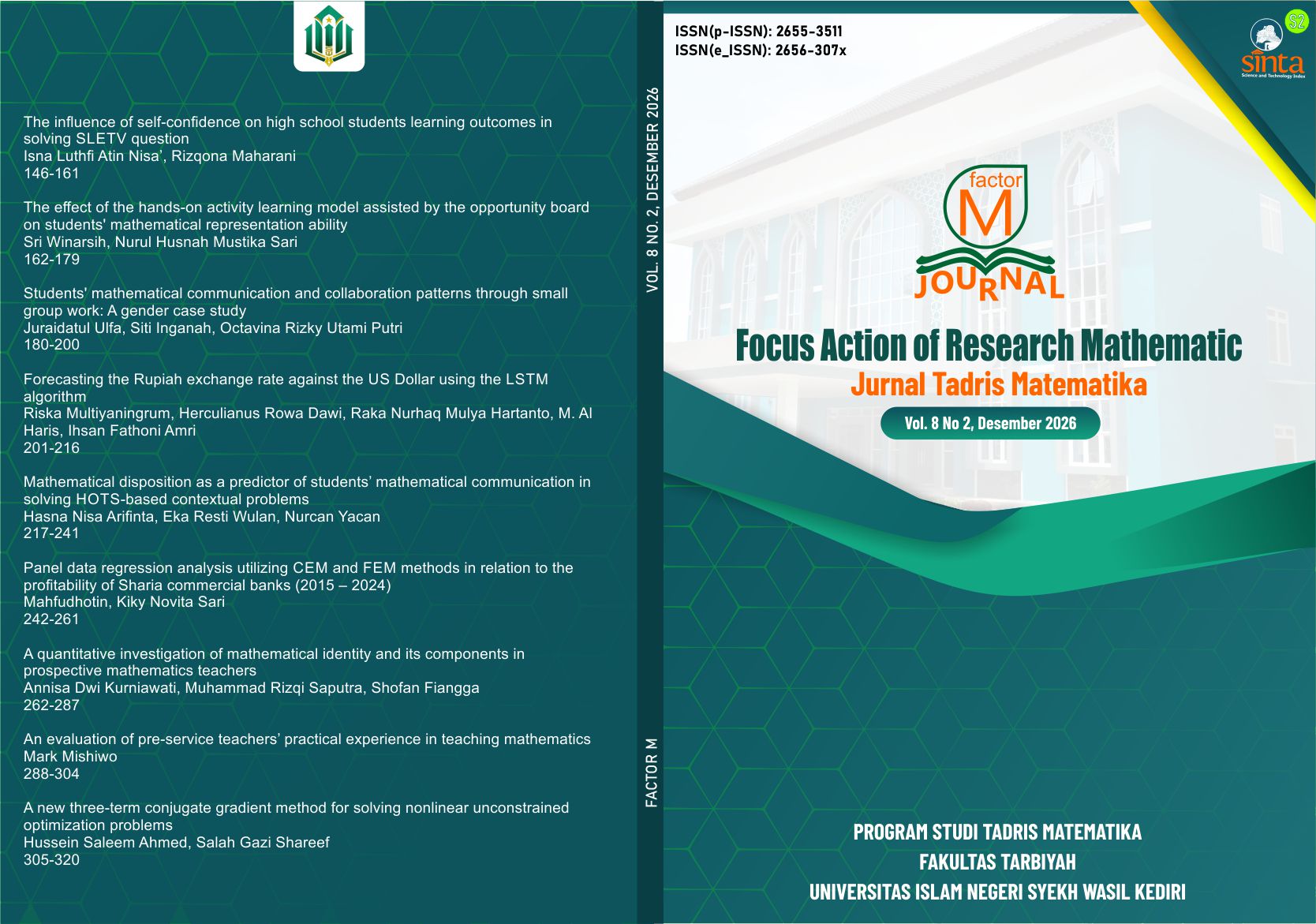
A quantitative investigation of mathematical identity and its components in prospective mathematics teachers
DOI:
https://doi.org/10.30762/f_m.v8i2.6373Keywords:
Mathematical Identity, Prospective Teachers, Prospective Mathematics Teachers, Descriptive QuantitativeAbstract
Mathematical identity has become a significant focus in mathematics education research because it influences how individuals perceive themselves as learners and practitioners of mathematics. Theoretical perspectives, including socio-cultural and discourse-based views, suggest that mathematical identity is constructed through personal experience, community recognition, and participation in mathematical practices. However, empirical research on the mathematical identity of prospective mathematics teachers remains limited, particularly studies that quantitatively examine the multiple components of identity before students enter the teaching profession. Addressing this gap, the present descriptive quantitative study investigates the mathematical identity of prospective mathematics teachers. A total of 88 participants completed the questionnaire on mathematical identity, which consisted of 18 items covering interest, recognition, competence, performance, and beliefs about mathematics. The responses were analyzed using descriptive statistical methods, including frequency distributions, mean scores, and categorical classifications. The results showed that 70.45% of prospective mathematics teacher students had a high mathematical identity. Component-level analysis revealed that 78.41% had high interest in mathematics, 55.68% had medium levels of recognition, 48.86% showed high competence beliefs, 92.04% scored high in performance beliefs, and 97.73% held strong positive beliefs about the nature of mathematics. This study contributes to the literature by providing a detailed quantitative profile of mathematical identity among prospective mathematics teachers. The findings suggest that teacher education programs should intentionally design learning environments that provide more opportunities for constructive feedback. Future research should examine the factors that shape and influence the development of mathematical identity, particularly through longitudinal or mixed-method approaches that can capture changes over time and provide deeper explanatory insights.
Downloads
References
Ababil, F. R. U., & Septianawati, E. (2021). Analisis kecenderungan mahasiswa tadris matematika dalam memilih aplikasi belajar berbasis e-learning berdasarkan minat belajar. Journal Focus Action of Research Mathematic (Factor M), 4(1), 21–30. https://doi.org/10.30762/factor-m.v4i1.3418
Akhyar, M. K., & Khiyarusoleh, U. (2022). Efektivitas self coaching model GROW ME terhadap hasil belajar mahasiswa mata kuliah trigonometri. Journal Focus Action of Research Mathematic (Factor M), 4(2), 43–54. https://doi.org/10.30762/factor_m.v4i2.4193
Aprinastuti, C., & Kovács, Z. (2022). Translating mathematical representations through cultural contexts: affective responses of Indonesian preservice teachers. Journal on Mathematics Education, 16(3), 765–782. https://doi.org/10.22342/jme.v16i3.pp765-782
Bates, A., Latham, N., & Kim, J. (2011). Linking preservice teachers' mathematics self‐efficacy and mathematics teaching efficacy to their mathematical performance. School Science and Mathematics, 111(7), 325–333. https://doi.org/10.1111/j.1949-8594.2011.00095.x
Bobis, J., Way, J., Anderson, J., & Martin, A. J. (2015). Challenging teacher beliefs about student engagement in mathematics. Journal of Mathematics Teacher Education, 19(1), 33–55. https://doi.org/10.1007/s10857-015-9300-4
Coskun, S. D., Sitrava, R. T., & Bostan, M. I. (2023). Pre-service elementary teachers' noticing expertise of students' mathematical thinking: The case of fractions. International Journal of Mathematical Education in Science and Technology, 54(6), 982–999. https://doi.org/10.1080/0020739X.2022.2095263
Cribbs, J., Tassell, J., Hazari, Z., Sadler, P. M., & Sonnert, G. (2022). Unpacking mathematics identity: exploring undergraduate students' enduring experiences. Revista Internacional De Pesquisa Em Educação Matemática, 12(2), 68–91. https://doi.org/10.37001/ripem.v12i2.2923
De Backer, L., Schelfhout, W., Simons, M., Vandervieren, E., & Rivera Espejo, J. (2023). Impact of team teaching on student teachers’ professional identity: a bayesian approach. Education Sciences, 13(11). https://doi.org/10.3390/educsci13111087
Dodsworth, D. (2019). Impact of a STEM education course on prospective elementary school teachers' identity. Proceedings of the 2019 AERA Annual Meeting. https://doi.org/10.3102/1445748
Gresham, G. (2017). Preservice to inservice: does mathematics anxiety change with teaching experience. Journal of Teacher Education, 69(1), 90–107. https://doi.org/10.1177/0022487117702580
Grootenboer, P. (2020). Mathematics education: Building mathematical identities. AIP Conference Proceedings, 2215(April), 060006. https://doi.org/10.1063/5.0000581
Handayani, U. F., Hakim, W., & Putri, A. O. (2022). Analisis kesalahan mahasiswa dalam pembuktian identitas trigonometri. Journal Focus Action of Research Mathematic (Factor M), 4(2), 27–42. https://doi.org/10.30762/FACTOR_M.V4I2.4146
Holincheck, N. M., & Galanti, T. M. (2025). STEM teacher identity and agency: a cross-case analysis of four teachers’ actions for equity in STEM. Journal for STEM Education Research. https://doi.org/10.1007/s41979-025-00163-2
Justicia Galiano, M. J., & Pelegrina, S. (2024). False beliefs about mathematics in pre-service teachers and relations with math anxiety. European Journal of Investigation in Health, Psychology and Education, 14(7), 1913–1926. https://doi.org/10.3390/ejihpe14070127
Kang, H. J., & Battey, D. (2017). Contextualizing the identity development of preservice elementary mathematics teachers in methods courses and mentor teacher support. Journal of Education and Development, 1(1), 24. https://doi.org/10.20849/jed.v1i1.248
Kitchen, R., Martinez-Archuleta, M., Gonzales, L., & Bicer, A. (2021). Actualizing change after experiencing significant mathematics pd: hearing from teachers of color about their practice and mathematical identities. Education Sciences, 11(11), 710. https://doi.org/10.3390/educsci11110710
Kurniawati, A. D. (2021). Indonesian students' perception about the effectiveness of e-learning implementation during covid-19. The New Educational Review, 66(4), 98–109. https://doi.org/10.15804/tner.2021.66.4.08
Kurniawati, A. D., Genarsih, T., & Nurhidayati, M. (2023). Motivation to learn mathematics on different personality types. Sainstek: Jurnal Sains Dan Teknologi, 15(1), 36–43. https://doi.org/10.31958/js.v15i1.7729
Kurniawati, A. D., Juniati, D., & Abadi. (2022). Development of the pre-service teachers' mathematics identity instrument (P-STMI). Acta Scientiae, 24(6), 338–369. https://doi.org/10.17648/acta.scientiae.7110
Kurniawati, A. D., Juniati, D., & Abadi, A. (2023). Mathematics identity of prospective mathematics teachers: content analysis of open-ended survey questions. Participatory Educational Research, 10(4), 181–201. https://doi.org/10.17275/per.23.73.10.4
Kurniawati, A. D., & Noviani, J. (2022). Motivational profiles of prospective mathematics teachers based on different types of personalities. Beta: Jurnal Tadris Matematika, 15(1), 20–36. https://doi.org/10.20414/betajtm.v15i1.502
Laursen, B., Hassi, M.-L., Kogan, M., & Weston, T. (2023). Development of prospective elementary teachers’ beliefs about mathematics during their first semester at university, and the impact of inquiry-based tasks. International Journal of Research in Undergraduate Mathematics Education, 11(2), 146–161. https://doi.org/10.1007/s40753-023-00232-0
Llagas, R. M. (2021). Prospective filipino teachers' disposition to mathematics. Mathematics and Statistics, 9(2), 93–97. https://doi.org/10.13189/ms.2021.090202
Lutovac, S., & Kaasila, R. (2013). Pre-service teacher's possible mathematical identities. Conference Proceedings. https://doi.org/10.1007/s10649-013-9500-8
Mandt, H. M. P. (2021). Negotiating identity within diverse educational ideologies. Journal of Research in Mathematics Education, 10(2), 213. https://doi.org/10.17583/redimat.2021.6194
Mandt, H. M. P., Cribbs, J., Tassell, J., Hazari, Z., Sadler, P. M., Sonnert, G., Lutovac, S., Kaasila, R., Jakopovic, P. M., Marshman, M., Goos, M., Barba, K., Heffernan, K. A., Newton, K. J., Mielicki, M. K., Schiller, L. K., Fitzsimmons, C. J., Scheibe, D., & Thompson, C. A. (2022). Negotiating identity within diverse educational ideologies. Journal of Mathematics Education at Teachers College, 85(2), 68–91. https://doi.org/10.17583/redimat.2021.6194
Miele, D. B., Browman, A. S., Shen, C., Vasilyeva, M., & Tyumeneva, Y. A. (2022). Domain-general and math-specific self-perceptions of perseverance as predictors of behavioral math persistence. The Journal of Experimental Education, 90(3), 593–614. https://doi.org/10.1080/00220973.2020.1813684
Mumcu, H. Y., & Aktaş, M. C. (2019). The effect of the use of mathematics course in terms of prospective teachers' attitudes toward mathematics and their beliefs on the nature, teaching, and learning of mathematics. Pegem Eğitim Ve Öğretim Dergisi, 9(3), 697–728. https://doi.org/10.14527/pegegog.2019.023
Pagiling, S. L., & Taufik, A. R. (2022). Unveiling belief and pedagogical content knowledge of prospective secondary mathematics teachers. Jurnal Elemen, 8(2), 411–426. https://doi.org/10.29408/jel.v8i2.5096
Pikk, K., Leijen, Ä., Radišić, J., & Uibu, K. (2025). Exploring the relationship between teachers’ beliefs on the nature and learning of mathematics and self-efficacy in teaching mathematics at the primary school level. LUMAT: International Journal on Math, Science and Technology Education, 13 (1), 3. https://doi.org/10.31129/LUMAT.13.1.2504
Pujilestari, S., Dwi Kartika, W., Lailaturrosidah, A., Bilangan, R., & Surah dan Ayat Al-Quran, T. (2022). Rahasia tartib surah dan ayat al-quran dari unsur bilangan (kajian pemikiran Izza Rohman). Journal Focus Action of Research Mathematic (Factor M), 4(2), 1–15. https://doi.org/10.30762/factor_m.v4i2.3671
Polizzi, S. J., Zhu, Y., Reid, J. W., & Geiger, V. L. (2021). Science and mathematics teacher communities of practice: social influences on discipline based identity and self efficacy beliefs. International Journal of STEM Education, 8(1), 30. https://doi.org/10.1186/s40594-021-00275-2
Santosa, Y. T., Setyaningsih, N., & Kholid, M. N. (2025). Profiles of mathematical identity among prospective mathematics teachers: A qualitative case study across mathematical ability levels. Al-Jabar: Jurnal Pendidikan Matematika, 16(2), 631–654. https://doi.org/10.24042/ajpm.v16i2.28718
Sfard, A. (2008). Thinking as communicating: Human development, the growth of discourses, and mathematizing. Cambridge University Press.
Shodiqin, A., Sukestiyarno, Wardono, Isnarto, I., Waluya, S. B., & Rochmad. (2020). Mathematical communication profile in solving probability problems reviewed by self-efficacy of prospective mathematics teachers. Universal Journal of Educational Research, 8(10), 4661–4670. https://doi.org/10.13189/ujer.2020.081035
Solomon, Y. (2009). Mathematical literacy: developing identities of inclusion. Routledge. https://doi.org/10.4324/9780203889275
Stoll, L., Duncan, A., & Tyler, G. (2022). Building personal resources for professional lives: pre service teachers’ experiences of professional learning communities. Education Sciences, 12(3), 1288. https://doi.org/10.3390/educsci120301288
Sulistyawati, E., & Radite, R. (2024). Exploring the quality of learning modules developed by preservice mathematics teacher based on the national (merdeka) curriculum. Journal Focus Action of Research Mathematic (Factor M), 7(1), 156–172. https://doi.org/10.30762/factor_m.v7i1.7926
Wenger, E. (1998). Communities of practice: learning, meaning, and identity. Cambridge University Press.
Yazidah, N., & Sulistyowati, Y. (2022). Analisis kesalahan dalam pembuktian teorema bilangan bulat pada mahasiswa IKIP Budi Utomo Malang. Journal Focus Action of Research Mathematic (Factor M), 4(2), 17–26. https://doi.org/10.30762/factor_m.v4i2.3903
Yeigh, T., Willis, R., James, S., Lake, W., Lynch, D., Peddell, L., Knight, B., Lee, M., & Samojlowicz, D. (2023). Teacher of mathematics identity as a predictor of teacher wellbeing. The Australian Educational Researcher, 50(5), 1403–1420. https://doi.org/10.1007/s13384-022-00588-w
Zakariya, Y. F., & Wardat, Y. (2024). Job satisfaction of mathematics teachers: an empirical investigation to quantify the contributions of teacher self efficacy and teacher motivation to teach. Mathematics Education Research Journal, 36(4), 791–813. https://doi.org/10.1007/s13394-023-00475-9
Downloads
Published
How to Cite
Issue
Section
License
Copyright (c) 2025 Annisa Dwi Kurniawati, Muhammad Rizqi Saputra, Shofan Fiangga

This work is licensed under a Creative Commons Attribution 4.0 International License.