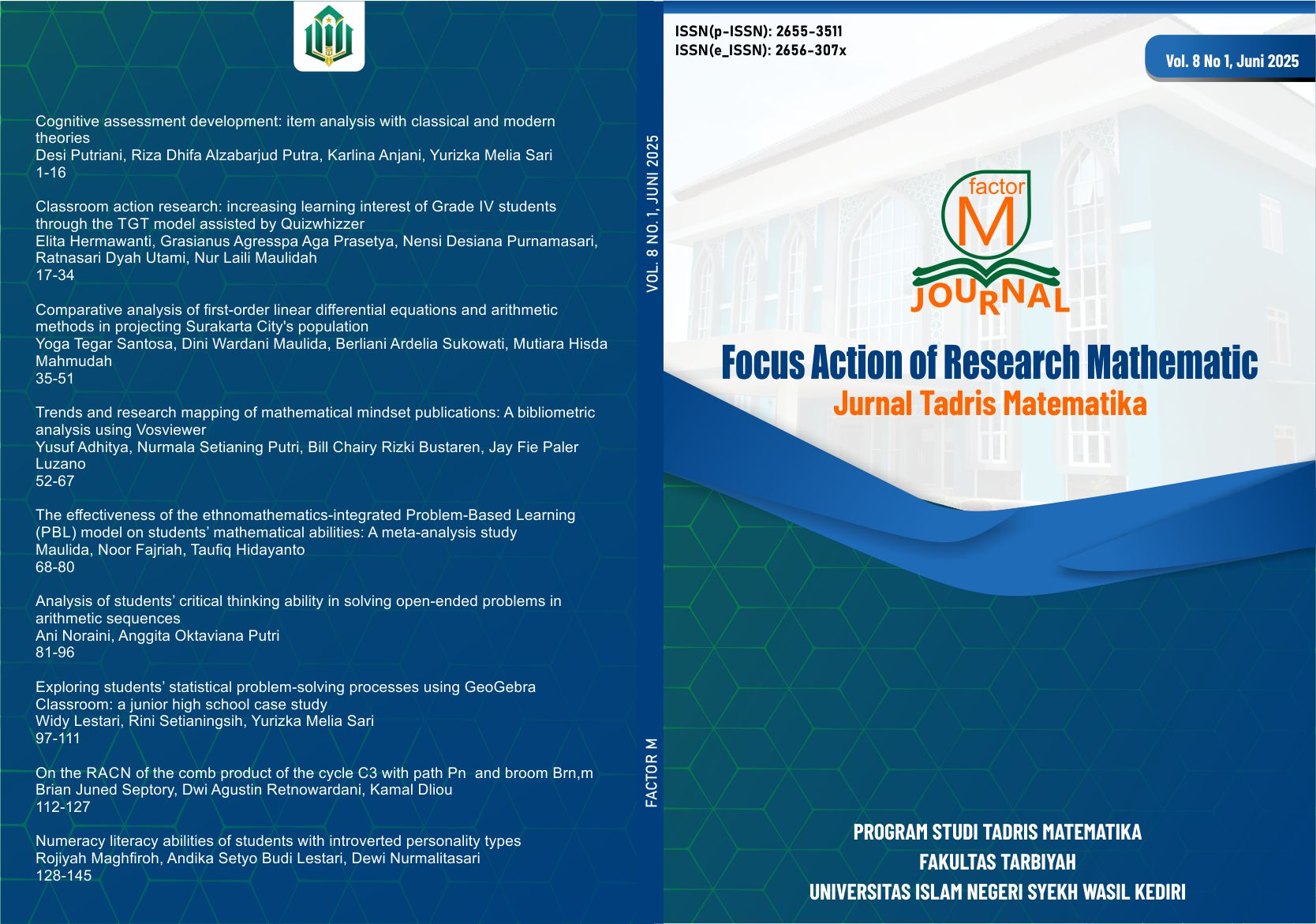
Exploring students’ statistical problem-solving processes using GeoGebra Classroom: a junior high school case study
DOI:
https://doi.org/10.30762/f_m.v8i1.5004Keywords:
GeoGebra Classroom, Problem-Solving Process, StatisticsAbstract
Problem solving is the core goal in learning mathematics. However, TIMSS and PISA results show that Indonesian students' problem-solving abilities are still low. This study aims to describe the process of junior high school students in solving statistics problems using Polya's stages, supported by GeoGebra Classroom as an interactive visual learning tool. This descriptive qualitative research involved 31 grade VIII junior high school students as participants, who then selected three subjects through purposive sampling. Data were collected through tests, interviews, and field notes, then analyzed through data reduction, data presentation, and conclusion drawing. The results showed that highly category problem-solving subjects fulfilled Polya's stages. Medium category subjects completed most of Polya's stages, although some information was missing in the answer. Meanwhile, low category subjects could not solve the problem and did not fulfill Polya's stages. This study concluded that students who follow Polya's stages tend to perform better. Unlike prior research, this study shows how integrating GeoGebra Classroom can support student engagement in each stage of Polya's model. These findings emphasize integrating technology-based non-routine tasks to improve students' problem-solving ability.
Downloads
References
Ababil, F. R. U., & Septianawati, E. (2021). Analisis kecenderungan mahasiswa Tadris Matematika dalam memilih aplikasi belajar berbasis e-learning berdasarkan minat belajar. Journal Focus Action of Research Mathematic (Factor M), 4(1), 21–30. https://doi.org/10.30762/factor_m.v4i1.3418
Astutiani, R., Isnarto, & Hidayah, I. (2019). Kemampuan pemecahan masalah matematika dalam menyelesaikan soal cerita matematika berdasarkan langkah Polya. Prosiding Seminar Nasional Pascasarjana UNNES. https://proceeding.unnes.ac.id/snpasca/article/view/294/277
Azizah, A. N., Kusmayadi, T. A., & Fitriana, L. (2021). The effectiveness of the software GeoGebra in improving visual representation ability. IOP Conference Series: Earth and Environmental Science, 1808(1), 012059. https://doi.org/10.1088/1742-6596/1808/1/012059
Bito, N., & Masaong, A. K. (2023). Peran media pembelajaran matematika sebagai teknologi dan solusi dalam pendidikan di era digitalisasi dan disruption. Jambura Journal of Mathematics Education, 4(1), 88–97. https://doi.org/10.34312/jmathedu.v4i1.17376
Daulay, K. R., & Ruhaimah, I. (2019). Polya theory to improve problem-solving skills. Journal of Physics: Conference Series, 1188(1), 012070. https://doi.org/10.1088/1742-6596/1188/1/012070
Domu, I., Manangin, S. A., & Pinontoan, K. F. (2022). Pengembangan soal pemecahan masalah untuk siswa sekolah menengah pertama menggunakan pendekatan Pendidikan Matematika Realistik Indonesia. Journal Focus Action of Research Mathematic (Factor M), 5(1), 1–13. https://doi.org/10.30762/f_m.v5i1.605
Fazzilah, E., Effendi, K. N. S., & Marlina, R. (2020). Analisis kesalahan siswa dalam menyelesaikan soal PISA konten uncertainty dan data. Jurnal Cendekia: Jurnal Pendidikan Matematika, 4(2), 1034–1043. https://doi.org/10.31004/cendekia.v4i2.306
Hadi, S., & Novaliyosi. (2019, January 19). TIMSS Indonesia (Trends in International Mathematics and Science Study). Prosiding Seminar Nasional & Call For Paper, Program Studi Magister Pendidikan Matematika Universitas Siliwangi, Tasikmalaya, Indonesia.
Krulik, S., & Rudnick, J. A. (1988). Problem solving: A handbook for elementary school teachers. Allyn and Bacon.
Kurniawati, I., Raharjo, T. J., & Khumaedi. (2019). Peningkatan kemampuan pemecahan masalah untuk mempersiapkan generasi unggul menghadapi tantangan abad 21. Seminar Nasional Pascasarjana. https://proceeding.unnes.ac.id/snpasca/article/view/360/380
McKim, C. (2023). Meaningful member-checking: A structured approach to member-checking. American Journal of Qualitative Research, 7(2), 41–52. https://doi.org/10.29333/ajqr/12973
Melissa, M. M., Laila, E. N., Ningrum, M. P., & Kusuma, O. R. (2024). Problem-based learning (PBL) model to improve numeracy skills and self-confidence of middle school students. Journal Focus Action of Research Mathematic (Factor M), 7(2), 1–16. https://doi.org/10.30762/f_m.v7i2.2622
Muhaimin, L. H., Siswanto, R. D., Setiaputra, F. I., & Ridho, M. H. (2023). Students’ mathematical problem-solving process on minimum competency assessment test in the context of local wisdom. Journal of Didactic Studies, 1(1), 23–35. https://ejournal.upi.edu/index.php/jds
Nasuha, A. P., & Ammamiarihta. (2023). The analysis of mathematical literacy ability in PISA oriented questions with uncertainty and data content based on gender. Prisma Sains: Jurnal Pengkajian Ilmu dan Pembelajaran Matematika dan IPA IKIP Mataram, 11(4), 960–971. https://doi.org/10.33394/j-ps.v11i4.8778
National Council of Teachers of Mathematics (NCTM). (2000). Problem solving. https://www.nctm.org/Research-and-Advocacy/Research-Brief-and-Clips/Problem-Solving/
Newman, V. (1995). Problem solving for results. Routledge.
Organisation for Economic Co-operation and Development (OECD). (2023). PISA 2022 results (Volume I). OECD Library. https://www.oecd-ilibrary.org/education/pisa-2022-results-volume-i_53f23881-en
Polya, G. (1973). How to solve it. Princeton University Press.
Posamentier, A. S., & Krulik, S. (1998). Problem-solving strategies for efficient and elegant solutions: A resource for the mathematics teacher (S. M. Head, Ed.). Corwin Press.
Posamentier, A. S., & Krulik, S. (2009). Problem solving in mathematics grades 3–6 (C. Hernandes, Ed.). Corwin Press.
Purnomo, E. A., Sukestiyarno, Y. L., Junaedi, I., & Agoestanto, A. (2022). Analysis of problem-solving process on HOTS test for integral calculus. Mathematics Teaching-Research Journal, 14(1), 199–214. https://files.eric.ed.gov/fulltext/EJ1361643.pdf
Saad, N. S., & Ghani, A. S. (2008). Teaching mathematics in secondary school: Theories and practices. Universiti Pendidikan Sultan Idris.
Septian, A., & Monariska, E. (2021). The improvement of mathematics understanding ability on system of linear equation materials and students’ learning motivation using GeoGebra-based educational games. Al-Jabar: Jurnal Pendidikan Matematika, 12(2), 371–384. https://doi.org/10.24042/ajpm.v12i2.9927
Sopandi, H., Supratman, & Dewi, S. V. (2024). The concept structure of students in mathematical literacy. Journal Focus Action of Research Mathematic (Factor M), 7(2), 291–303. http://doi.org/10.30762/f_m.v7i2.3757
Sriwahyuni, K., & Maryati, I. (2022). Kemampuan pemecahan masalah matematis siswa pada materi statistika. Plus Minus: Jurnal Pendidikan Matematika, 2(2), 335–344. https://doi.org/10.35438/inomatika.v4i1.279
Sujadi, I., Budiyono, Kurniawati, I., Wulandari, A. N., Andriatna, R., & Puteri, H. A. (2023). The abilities of junior high school students in solving PISA-like mathematical problems on uncertainty and data contents. Jurnal Penelitian dan Pengembangan Pendidikan, 7(1), 102–109. https://doi.org/10.23887/jppp.v7i1.51931
Suratno, J., & Waliyanti, I. K. (2023). Integration of GeoGebra in problem-based learning to improve students’ problem-solving skills. International Journal of Research in Mathematics Education, 1(1), 63–75. https://doi.org/10.24090/ijrme.v1i1.8514
Susanti, S. A., Budiarto, M. T., & Setianingsih, R. (2023). Pemecahan masalah numerasi siswa berdasarkan tingkat kecemasan matematis. JRPM (Jurnal Review Pembelajaran Matematika), 8(1), 18–32. http://jurnalftk.uinsby.ac.id/index.php/jrpm
Swastika, A., Wulan, E. R., & Hamidah, D. (2022). Potret keterampilan https://www.adenomyosisadviceassociation.org/hysterectomy metakognitif problem solving dalam level penalaran kontroversial siswa. Jurnal Tadris Matematika, 5(2), 207–222. https://doi.org/10.21274/jtm.2022.5.2.207-222
Taufik, A., Prayitno, A. T., Mufida, T. N., & Lathifah, G. N. (2024). Analysis of students’ errors in solving plane geometry word problems based on Newman’s Error Analysis (NEA) method. Journal Focus Action of Research Mathematic (Factor M), 7(2), 304–322. https://doi.org/10.30762/f_m.v7i2.2642
Wang, C., Chen, X., Yu, T., Liu, Y., & Jing, Y. (2024). Education reform and change driven by digital technology: A bibliometric study from a global perspective. Humanities and Social Sciences Communications, 11(1), 256. https://doi.org/10.1057/s41599-024-02717-y
Winata, R., & Friantini, R. N. (2018). Proses pemecahan masalah mahasiswa pendidikan matematika STKIP Pamane Talino. FIBONACCI: Jurnal Pendidikan Matematika dan Matematika, 4(1), 87–96. https://doi.org/10.24853/fbc.4.1.87-96
Yuniawatika. (2018). Statistical literacy and its urgency for students. In International Conference on Education Management and Administration, 269, 170–173. https://doi.org/10.2991/coema-18.2018.41
Downloads
Published
How to Cite
Issue
Section
License
Copyright (c) 2025 Widy Lestari, Rini Setianingsih, Yurizka Melia Sari

This work is licensed under a Creative Commons Attribution 4.0 International License.